



The Math of Motivation: The Highest-Margin Tool for Gyms
3D Scans are a High-Margin Tool for Gyms
In the fitness industry, we often talk about “value-adds.” We look for gadgets and software that make our facilities look modern, but we rarely talk about the actual return those tools generate.
For the modern gym owner—the one balancing personal training, small group classes, and high-ticket nutrition coaching—every dollar spent on overhead should have a purpose. If a tool doesn’t directly increase acquisition, improve retention, or support a higher-value service, it can quickly become digital clutter.
This is where the math of SNAP by Fit3D gets interesting. By removing the $5,000–$10,000 barrier of traditional scanning hardware and replacing it with a low monthly cost, SNAP dramatically changes the economics of offering 3D body scanning.
1. The Low-Cost Entry: As Low as $83/Month vs. a $70 Session
Most premium fitness technologies require a leap of faith. You buy a piece of equipment upfront and hope that over the next several years it pays for itself.
SNAP flips that model.
Consider a facility where Personal Training is priced at $70 per session with a standard 10-session commitment. That is a $700 contract.
With SNAP plans available for as low as approximately $83/month, a single personal training sale can cover many months of the service.
If a coach uses a 3D scan to help a prospect visualize changes in their body shape, measurements, or posture—and that experience helps close just one 10-pack—the technology has effectively paid for itself for months.
At that point, SNAP is less like another software expense and more like a sales tool that supports your coaches every day.
2. The High-Ticket Anchor: The $800 Nutrition Contract
The hardest sale in many gyms is the $800/month nutrition program. Why? Because nutrition is often “invisible” work. Unlike adding weight to a deadlift, you can’t always feel nutrition working in the first 14 days.
When a client commits to an $800/month program with a three-month minimum, they are handing you $2,400.
At that price point, the bathroom scale can become your worst enemy. If that client follows your plan but happens to retain water on weigh-in day, the number on the scale may barely move. The client can begin to question whether their investment is working.
SNAP helps turn the invisible into something visible.
By showing changes in 3D body shape and circumference measurements over time—even when body weight is relatively stable—you give clients additional ways to understand their progress.
The Math: One $2,400 nutrition contract can cover well over two years of SNAP at the lowest monthly-equivalent pricing.
That is an unusually small technology cost relative to the value of the service you are selling.
3. The Compounding Power of Retention
This is where the math can become even more meaningful.
Imagine your base membership is $89/month. For many gyms, cancellations happen when members stop feeling like they are making progress.
If SNAP helps you retain even a small number of members by giving them another way to see and understand their results, the subscription can quickly become cash-flow positive.
For example:
- Month 1: You retain 2 members ($178 in monthly revenue).
- Month 2: Those members remain, and you retain 2 more ($356 in monthly recurring revenue).
- Month 6: That retained group can represent more than $1,000/month in membership revenue.
That is the compounding effect.
By providing a 3D Wellness Assessment every 30 days, you are not just selling access to gym equipment. You are giving members measurable milestones along their journey and another reason to stay engaged.
4. Low Overhead: The Silent Profit Margin
We often forget the hidden costs of fitness technology:
- Shipping and freight for heavy equipment.
- Floor space, which has a real dollar-per-square-foot value.
- Maintenance and calibration.
- Specialized setup or installation.
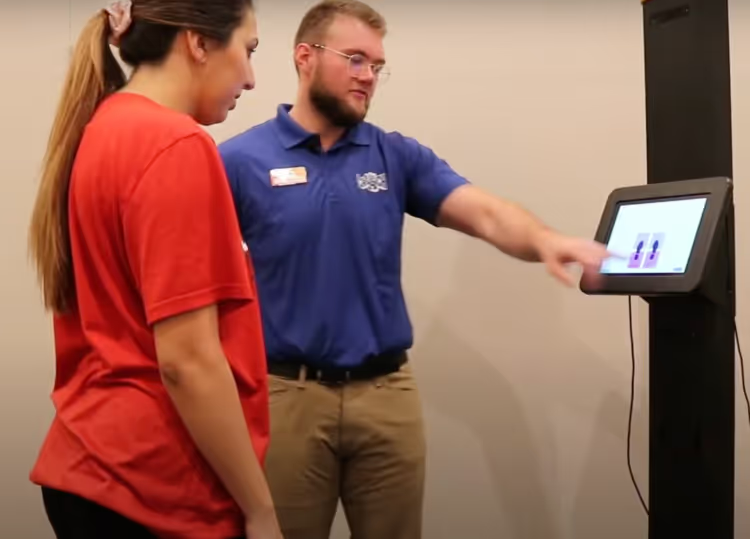
SNAP has no expensive custom scanning hardware. It runs on supported Samsung Galaxy tablets that are inexpensive and easy to source locally.
That means there is no large equipment investment that has to be recovered before the system begins generating value.
Your ROI can begin with the first client you scan.
5. Moving from “Maybe” to “Yes”
Sales in the fitness industry often comes down to a tension between logic and emotion.
- The Logical Mind says: “$800 a month for nutrition is a lot of money.”
- The Emotional Side says: “I want to look and feel different.”
A 3D scan can help bridge that gap.
It takes the desire to change and adds visual, measurable information that helps clients better understand what is happening to their bodies over time.
For higher-ticket coaching services, that additional layer of measurement can help reinforce the value of the program before and after the sale.
The SNAP 3D Wellness Movement
We are moving into an era of professionalized fitness.
Clients are increasingly accustomed to metrics, dashboards, wearables, and personalized data. They want more than “trust me, you’re making progress.”
For a low monthly cost, SNAP gives gyms another way to:
- Increase the value of sales consultations.
- Support higher-value coaching and nutrition programs.
- Give members additional reasons to stay engaged and renew.
The question for a modern gym owner isn’t simply, “Can I afford SNAP?”
The more useful question may be:
“How much revenue could I be leaving on the table without a better way to show clients their progress?”


Subscribe to
our Newsletter!
