


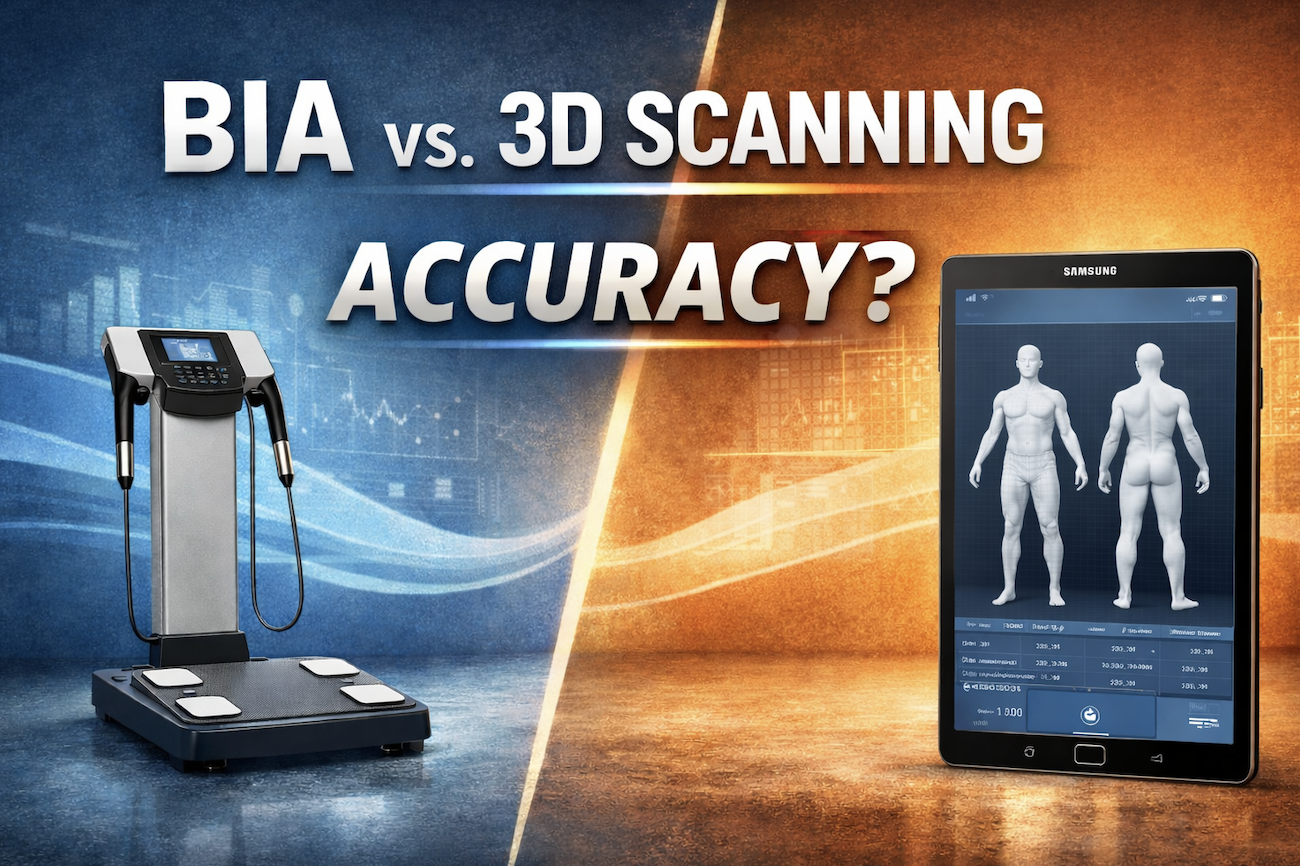
Is BIA more accurate than 3d Scanning?
BIA vs 3D Body Scanners on Accuracy - What's true?
If you’re comparing bioelectrical impedance analysis (BIA) and 3D body scanning, the most common question is simple:
Is BIA more accurate than 3D scanning?
The honest answer: "No".
In real-world use, BIA and 3D body scanning tend to fall within a similar accuracy range when validated against reference methods like DXA. Neither technology consistently outperforms the other across populations.
BIA is often perceived as more accurate because it’s older & more clinical— not because it consistently outperforms modern 3D scanning in validated body fat estimation. This is a myth that has been perpetuated by the Fitness Industry.
How accurate is BIA?
BIA estimates body composition by measuring electrical impedance in the body. Because electrical current travels more easily through water than fat, BIA primarily measures hydration and total body water, then uses validated equations to estimate fat-free mass and body fat percentage.
When compared to DXA in controlled conditions, modern BIA systems commonly report body fat percentage errors in the ~3–5% range. Accuracy depends heavily on hydration status, testing protocol, and consistency.
How accurate is 3D body scanning?
3D body scanners estimate body composition using a completely different methodology. Instead of electrical signals, they capture external body geometry — including body volume, shape, and circumferences — and apply predictive models that have been correlated to DXA data.
Multiple validation studies show that modern 3D scanning systems can achieve body fat percentage errors around ~3–4%* when compared to DXA, placing them in a similar accuracy range to BIA when used correctly and consistently.
Note: Every brand has studies that show in certain conditions their accuracy outperforms this accuracy band. Here is Fit3D's study.
The honest reality about accuracy
Neither BIA nor 3D body scanning directly measures body fat. They measure one property, and correlate it to Body Fat percentages indirectly through proportions & prediction models.
Both technologies:
- Use indirect measurements
- Apply statistical models
- Correlate outputs to DXA reference data
- Are best suited for tracking change over time, not determining an absolute “true” body fat percentage
The key difference is how they infer body composition:
- BIA uses hydration and electrical impedance metrics and correlates those values to DXA outcomes.
- 3D body scanners use body volume, shape, and circumference data and correlate those measurements to DXA outcomes.
They are different methodologies solving the same problem, not competing on fundamentally different levels of accuracy.
So, if they are both are accurate enough, where is the value of 3D scanning?
Scanning Provides New Features that BIA Cannot Offer
While accuracy may be comparable, 3D body scanning delivers something BIA cannot:
- Visual 3D body models that motivate people & educate what physique is.
- Precise circumference body measurements
- Clear visualization of shape changes
For many users, seeing progress is more motivating than reading a number, which makes 3D scanning especially valuable for client engagement, retention, and experience.
Why would you choose a BIA solution in 2026?
Some larger operations continue to use legacy BIA systems simply because they’re already embedded in their workflow. For gyms that follow an “if it isn’t broken, don’t fix it” mindset, BIA remains familiar and dependable. BIA assessments typically take one minute or less, whereas a full 3D scan may take 2–3* minutes end-to-end. That speed and simplicity can matter in high-turnover environments, where streamlined processes and minimal staff training are priorities.
*Note: SNAP scans take about 10 seconds to complete, but there is also user account creation & scan processing that takes some more time adding up to that 2-3 minute band.
FAQ: Can you use both BIA & 3D Scans Together?
Yes, we do have clients that use BIA for their body fat metrics, and use Fit3D scans for their visuals. This is very much possible & affordable. We have an article about that here.

Subscribe to
our Newsletter!
