


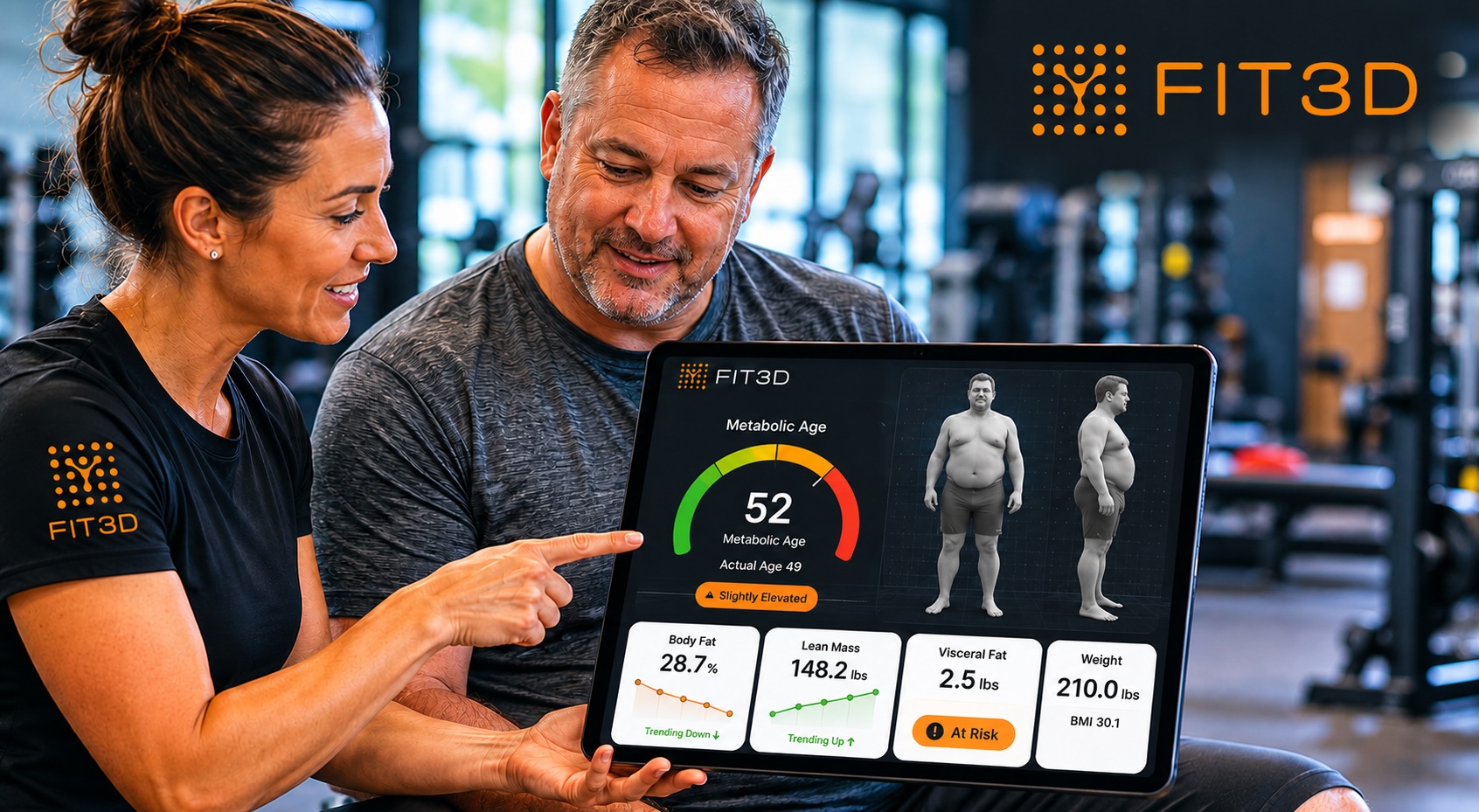
Why Metabolic Age Should Be Part of Every Wellness Intake and Retention Program
Why Metabolic Age Should Be Part of Every Wellness Intake and Retention Program
Most people who walk into a gym, personal training studio, physical therapy clinic, or wellness center want the same thing: progress.
They may want to lose weight, build strength, improve mobility, reduce pain, feel younger, or get healthier. But underneath all of those goals is one simple question:
“Am I getting better?”
For commercial wellness businesses, answering that question is not always easy.
Weight does not tell the full story. Body fat percentage can be confusing. Circumference measurements are helpful, but not always exciting. Lean mass, visceral fat, posture, and body composition are all valuable, but they can overwhelm the average consumer if they are not explained clearly.
SNAP by Fit3D helps bring these metrics together in a single assessment, but even then, clients often need a simple place to focus.
That is why metabolic age is such a powerful metric.
Metabolic age gives members, clients, and patients a simple way to understand their progress. It compares how their body is functioning from a metabolic perspective against their actual age. If their metabolic age is at or below their chronological age, that is a positive signal. If it is above their chronological age, it creates a clear opportunity for improvement.
For a consumer, that is easy to understand.
If I am 45 and my metabolic age is 42, I feel like I am doing something right.
If I am 45 and my metabolic age is 52, I immediately understand that I have work to do.
That simplicity is what makes metabolic age so valuable for wellness businesses.
Metabolic Age Makes Progress Easier to Understand
Most fitness and wellness programs are built around behavior change. The goal is to help clients train consistently, eat better, sleep more, manage stress, build muscle, lose fat, and stay engaged long enough to see results.
But behavior change requires feedback.
The problem is that traditional metrics can create confusion if they are not framed correctly. Scale weight can move slowly. Sometimes it does not move at all, even when someone is building muscle and losing fat. Body fat percentage can feel abstract. Measurements require context. Medical markers are important, but they are often not available during a normal gym or wellness check-in.
Metabolic age simplifies the story.
It gives the client one number they can understand quickly. It does not replace deeper body composition data, but it helps translate that data into a more emotional and actionable message.
Instead of saying:
“Your body fat decreased, lean mass improved, and your estimated basal metabolic rate increased.”
A coach can say:
“Your metabolic age improved by three years. That means your body is trending in the right direction.”
The first version is technical. The second version is motivating.
Why It Matters During Intake
The intake experience is one of the most important moments in any wellness business.
This is when a new member, client, or patient is most motivated. They are ready to change. They are looking for guidance. They want to know where they stand and what they should do next.
Metabolic age gives the business a simple starting point.
For gyms, it can make onboarding feel more personal. Instead of only giving someone a tour and showing them equipment, the gym can help the member understand their current body and metabolic baseline.
For personal training businesses, it creates a natural bridge into coaching. If a client’s metabolic age is higher than their actual age, the trainer has a clear reason to recommend strength training, cardio, nutrition support, and consistent check-ins.
For physical therapy and recovery-focused businesses, metabolic age can support a broader wellness conversation. A patient may come in because of pain, mobility, or injury recovery, but metabolic health often connects to strength, function, body composition, and long-term quality of life.
The key is not to use metabolic age as a scare tactic. It should be used as a simple baseline.
“At intake, this is where you are. Over the next 90 days, our goal is to help you move this number in the right direction.”
That gives the client a target that feels personal.
Why It Matters for Retention
Retention is built on perceived progress.
People stay with a gym, trainer, clinic, or wellness program when they believe the program is working. They cancel when they feel stuck, confused, unsupported, or unsure whether their effort is paying off.
This is where metabolic age can become a powerful retention tool.
A member may not lose 20 pounds in the first two months. A personal training client may not see dramatic visual changes right away. A physical therapy patient may still be working through pain or movement limitations.
But if their metabolic age improves, the business has a meaningful progress story to tell.
“You may not be at your final goal yet, but your metabolic age has dropped from 51 to 47. That is a strong sign that your effort is paying off.”
That kind of feedback helps people stay engaged.
It also creates a reason for regular check-ins. Instead of only measuring someone at the beginning and end of a program, businesses can use metabolic age as part of a recurring progress rhythm:
Capture the starting point at intake.
Review early changes at 30 days.
Connect progress to training and lifestyle at 60 days.
Celebrate improvement and set the next goal at 90 days.
This turns a wellness program into an ongoing journey instead of a one-time transaction.
Metabolic Age Helps Coaches Tell a Better Story
The best wellness businesses do more than collect data. They explain it.
Metabolic age gives coaches, trainers, and specialists a simple way to connect technical body data to a client’s real-world goals.
If metabolic age is below actual age, the message is positive:
“You are doing great. Your body is responding well. Let’s keep building on this and see if we can take another year off.”
If metabolic age is above actual age, the message becomes action-oriented:
“This gives us a clear opportunity. We are going to focus on strength training, consistent movement, nutrition habits, sleep, and recovery. Then we will track this over time and work to bring that number down.”
That conversation is simple, but powerful.
It helps the client understand why the program matters. Personal training is not just a workout. Nutrition coaching is not just a meal plan. Physical therapy is not just rehab. Membership is not just access to equipment.
The program becomes a path toward measurable improvement.
Where SNAP by Fit3D Fits In
For commercial wellness businesses, the challenge is not just knowing that metabolic age matters. The challenge is making it easy to measure, explain, and track.
That is where SNAP by Fit3D can help.
SNAP gives wellness businesses a simple way to capture body data and turn it into a visual, client-friendly experience. Instead of relying only on weight, manual measurements, or disconnected assessments, businesses can give clients a more complete view of their body and progress.
Metabolic age can become one of the easiest metrics to explain during that process.
It gives the client a number they understand. It gives the coach a conversation starter. It gives the business a reason to bring people back for regular progress reviews.
Most importantly, it helps clients see that their effort is creating change.
The Bottom Line
Metabolic age should not be treated as a medical diagnosis or the only measure of health. But as an engagement metric, it can be extremely valuable.
It takes complex body composition and metabolism-related information and turns it into a simple question:
“Is my body trending younger or older than my actual age?”
For gyms, personal training studios, physical therapy specialists, and wellness businesses, that simplicity matters.
When clients understand their starting point, know what they are working toward, and can see progress over time, they are more likely to stay engaged.
And when clients stay engaged, businesses have a better chance to improve outcomes, build stronger relationships, and retain more members.
Metabolic age gives wellness businesses a better way to start the conversation, guide the program, and keep clients coming back to see what is possible next.


Subscribe to
our Newsletter!
