


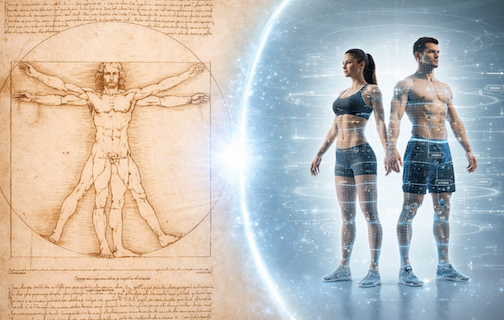
From DaVinci's Vitruvian Man to 3D Scans: A Fresh Perspective
The Original Body Scan (Circa 1490)
Back in the 1400s, Leonardo da Vinci sketched what might be the world’s first attempt at body measurement.
Arms out. Legs spread. Perfectly balanced inside a circle and a square.
It wasn’t just art—it was an early exploration of how the human body could be understood through proportion. As a fun side fact, I was able to run the initial parts of his writing through AI to actually read his notes on this piece Vitruvian Man.
Inspired by Vitruvius, Leonardo believed the body followed consistent ratios:
- Arm span equals height
- Hand is ~1/10 of the body
- Foot is ~1/6
It was a brilliant idea for its time.
But there was one small problem.
The Problem With “Perfect Proportions”
The Vitruvian Man assumes there’s an ideal body—a universal template.
But in real life:
- Two people can share the same proportions
- And look completely different
- With very different health outcomes
Because proportions don’t tell you:
- Body fat
- Muscle mass
- Inches lost
- Or how a body is changing
It’s a static model in a dynamic world.
Fast Forward 500 Years
Today, the question has changed:
Not “Do you fit the ideal?”
But “How is your body changing?”
Modern body composition systems follow a surprisingly similar logic to Leonardo—just with more data.
We still look for patterns:
- How different parts of the body relate
- How shape and distribution vary
- How external measurements connect to internal changes
But now we can:
- Capture hundreds of data points
- Track circumference changes
- Compare results over time
And importantly—we can connect those patterns to clinical research.
Many modern models are built by linking:
- External body shape
- To internal measurements (like fat and muscle)
It’s the same idea Leonardo explored—pattern recognition—just scaled with technology. This is the basis for how companies come up with models for metrics like visceral fat & metabolic age.
From Static to Dynamic
The Vitruvian Man is a snapshot.
Modern body tracking is a story.
Not one moment—but a timeline:
- Inches lost
- Shape changes
- Visible transformation
And that’s what actually matters.
Because no one really cares if their arm span equals their height.
They care if:
- Their waist is shrinking
- Their clothes fit better
- Their progress is visible
The Real Upgrade
If Leonardo were around today, he probably wouldn’t stop at the sketch.
He’d want:
- Data
- Visualization
- And a way to track change over time
That’s the real evolution.
Not replacing the original idea—but extending it.
From ideal proportions → to measurable transformation over time.
Final Thought
We’re not Renaissance artists. But we do understand body composition. You could say we were the revolutionaries that brought body tech out of the BIA dark ages into the light of next historical era!
And more importantly—we help people see their progress.
Because when you can see change, you believe it.
And when you believe it, you stick with it.
If you want to see how FIt3D can help out your business, check out our new scanning solution SNAP.
Ps. To my Art History teacher, it looks like I was paying attention!




Subscribe to
our Newsletter!
