


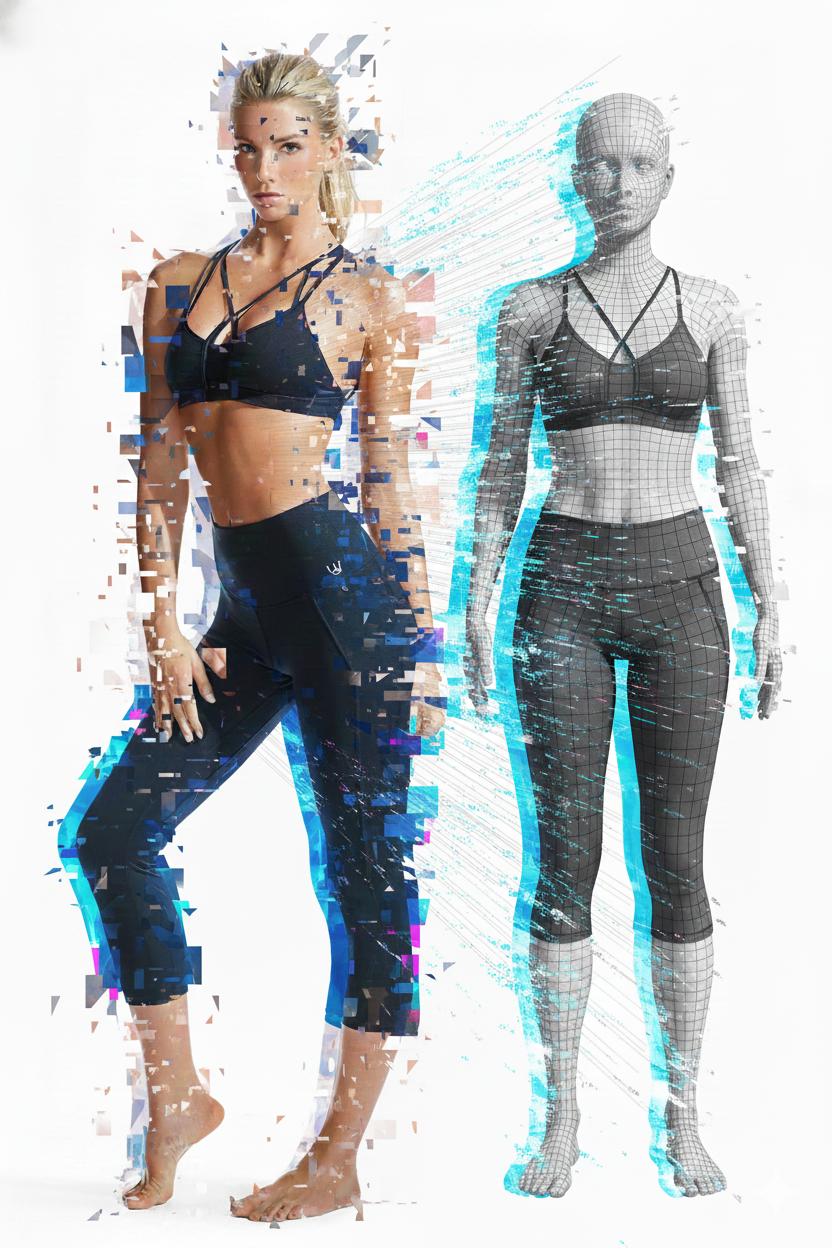
Rigid vs. Non-Rigid Capture: How Body Scanning Has Evolved
This article is a continuation of the previous article on why Fit3D has moved away from the outdated bulky scanner models. Technology has evolved, and we decided to embrace it for the sake of our customers - resulting in better scans and nearly 80% of our customer support tickets going away.
Nearly a decade ago, rigid capture was the best technology available. Both Fit3D and Styku built their early systems around it, and at the time, it made sense.
A decade later, the technology has moved on.
Why Rigid Capture Is Now an Outdated Approach
Rigid capture assumes the body behaves like a static object. The avatar is constructed as a single, inflexible shape, meaning any difference between scans—posture, breathing, balance, arm position—is interpreted as a change in the body itself.
In real-world environments, this creates problems.
Humans move. They breathe. This is the 3-5% error that all 3DO Systems have from stepping on those 3d scanner platforms. If you have had a ProScanner or Styku scan before, this is what causes the rare missing arm, distorted face or scan artifacts. Rigid systems struggle with that variability, which leads to:
- Scan failures
- Inconsistent measurements
- Frequent rescans
- Confusing or contradictory results for clients
Over time, those issues surface as higher support volume, frustrated staff, and reduced client trust. When scans feel unreliable, the technology becomes harder to sell—and harder to keep. This is why Fit3D decided to evolve to SNAP - it was a better overall experience for our operators.
Rigid capture wasn’t designed for how people actually move. It was designed for the limitations of the hardware available a decade ago.
The Shift to Non-Rigid Capture
Non-rigid capture represents the next stage in body scanning. Welcome to 2025!
Instead of treating the body as a fixed object, non-rigid systems model it as what it is: dynamic and adaptable. Different regions of the body can move independently, allowing the system to separate posture and pose from true anatomical change.This speaks to things like real-time tracking of joints, and reposing skeletons for better comparisons between scans. Things we can do in 2025 that we could not do in 2015.
This shift dramatically reduces many of the issues associated with rigid capture:
- Greater tolerance for natural movement
- Fewer failed scans
- More consistent results over time
- Less need for strict positioning or rescans
Fit3D transitioned to non-rigid capture with SNAP because it better reflects how scans are actually performed in gyms, medspas, and clinics—not controlled lab environments.
As an side effect, you can run scans on a $500 consumer tablet versus forcing customers to buy unit at $8000. It's better quality & much much cheaper.
Why Didn’t Everyone Switch?
If non-rigid capture is better, a fair question is: why haven’t all platforms moved to it?
Likely - they will. The answer isn’t technical—it’s structural.
Switching to non-rigid capture isn’t a simple software update. It requires:
- Rebuilding core modeling architecture
- Rethinking how scans are captured and processed
- Changing how hardware is positioned in the product
- In many cases, reworking long-standing business models
Some platforms were built around selling large, hardware-heavy machines. Those systems were designed to support rigid capture and justify their form factor. Moving away from that approach means more than changing technology—it means changing how the product is packaged, sold, and supported.
Evolution is harder than maintenance. It’s often easier to stay with proven, legacy systems than to re-architect everything underneath them.
Fit3D’s Approach: Evolve With the Technology
Fit3D made the decision to evolve.
Rigid capture was the right choice when the technology was first introduced. Non-rigid capture is the right choice now. By updating our architecture, Fit3D reduced scan errors, improved consistency, and lowered operational friction for operators.
This evolution mirrors what happens across technology over time. Early breakthroughs rely on specialized hardware. As software improves and computing power increases, better approaches replace the old ones.
Body scanning is no different.
The Bottom Line
Rigid capture wasn’t a mistake—it was a starting point.
But today, it introduces unnecessary errors, operational complexity, and client frustration. Non-rigid capture reflects a more modern understanding of the human body and how scans are performed in real life.
Fit3D chose to move forward.
Because better results don’t come from staying comfortable with old technology.
They come from evolving when the technology allows it.


Subscribe to
our Newsletter!
