


Fitness Challenge Dashboards Are Broken (Here’s a Better Way)
Most fitness challenges fail for one simple reason:
They measure success the wrong way.
While gyms invest in tools from companies like Styku, Evolt, InBody, and Visbody, the dashboards that power their challenges haven’t evolved.
They still rely on:
- Weight loss
- Body fat % change
- Simple rankings
And that’s the problem. Bigger Companies are still selling you old solutions that help them make money, but give very little value to you.
What Do Most Fitness Challenge Dashboards Measure?
Most platforms measure success using only 1–2 metrics:
- Weight lost
- Body fat percentage reduced
Some include lean mass—but rarely in a meaningful way.
Even when leaderboards exist, they are:
- Predefined
- Rigid
- Limited to a single ranking method
This creates a one-size-fits-all definition of success.
Why Traditional Challenge Leaderboards Don’t Work
Real clients don’t progress the same way.
Here’s what actually happens in an 8-week challenge:
- A beginner loses 20 lbs → wins
- An athlete gains 6 lbs of muscle → loses
- A recomposition client loses fat and gains muscle → unclear
- A GLP-1 client loses inches, not weight → undervalued
These are all successful outcomes.
But traditional dashboards only reward one of them.
The result:
- Your best transformations don’t win
- Advanced clients disengage
- Your challenge feels unfair
What Should a Fitness Challenge Measure Instead?
A modern challenge should recognize multiple types of success:
- Fat loss
- Muscle gain
- Body recomposition
- Inches lost (circumference changes)
- Visual body transformation
Instead of asking:
“Who lost the most weight?”
You should ask:
“Who improved the most—and how?”
The New Model: Raw Data + AI Analysis
The biggest shift happening right now is simple:
Stop relying on rigid dashboards. Start using raw data.
With full body composition data, you can analyze results in multiple ways using tools like ChatGPT.
Example ways to rank a challenge:
- Highest % body fat loss
- Most lean muscle gained
- Best recomposition (fat loss + muscle gain)
- Most inches lost
- Best transformation relative to starting point
Instead of one winner, you can create:
- Best Fat Loss Winner
- Best Muscle Gain Winner
- Best Recomposition Winner
- Most Inches Lost
- Most Consistent Progress
Now your leaderboard reflects reality.
Why This Approach Performs Better (Business Impact)
When clients feel like:
- Their goals are recognized
- Their progress is measured accurately
- They actually have a chance to win
They:
- Stay longer
- Engage more
- Refer others
- Buy more services
Rigid dashboards reduce motivation.
Flexible data increases retention and revenue.
Turning Challenge Results Into Marketing (The 3D Advantage)
Most dashboards stop at numbers.
But numbers don’t convert.
With 3D body scanning, you can show:
- Before vs after avatars
- Side-by-side body shape changes
- Regional fat loss
Instead of saying:
“Client lost 8% body fat” - You show it visually.
This creates:
- Stronger testimonials
- Better social media content
- Higher conversion on ads
- More trust from prospects
Your winners become your best marketing assets.
The Fit3D Approach
Fit3D takes a different approach.
Instead of building a more complex leaderboard…We remove the limitations entirely.
With Fit3D:
- You capture full-body data (fat, muscle, measurements, shape)
- You keep access to the raw data
- You can analyze results flexibly
- You can present transformation outcomes visually with 3D scans
This allows you to:
- Run better challenges
- Tell better stories
- Create more meaningful wins
The Bottom Line
Old model:
- One leaderboard
- One metric
- One winner
New model:
- Multiple outcomes
- Flexible scoring
- Personalized success
- Visual storytelling
The future of fitness challenges isn’t about better dashboards.
It’s about better use of data.
How to Run a Smarter 8-Week Challenge
- Collect full body composition data (not just weight)
- Store raw scan data for each participant
- Analyze results using multiple scoring models
- Select multiple winners based on different outcomes
- Use 3D visuals to showcase transformations
Final Thought
The question is no longer:
“What does your dashboard show?”
The question is:
“What story can you tell with your data?”
What do you need to get Started with 3D Scanning?
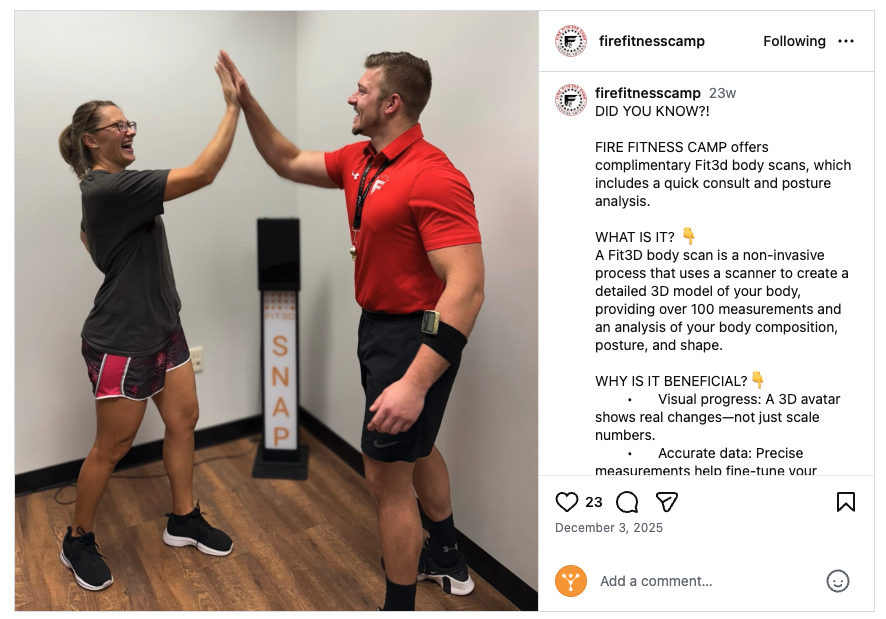
Check out SNAP by Fit3D. It's our tablet based solution that provides 3D scan data to your facility without the long term contracts & overpriced hardware.
If you want to to learn more why we evolved from our big bulky scanner to the higher resolution app based model, check out this piece on The Evolution of 3D Scanning.
.png)


Subscribe to
our Newsletter!
