


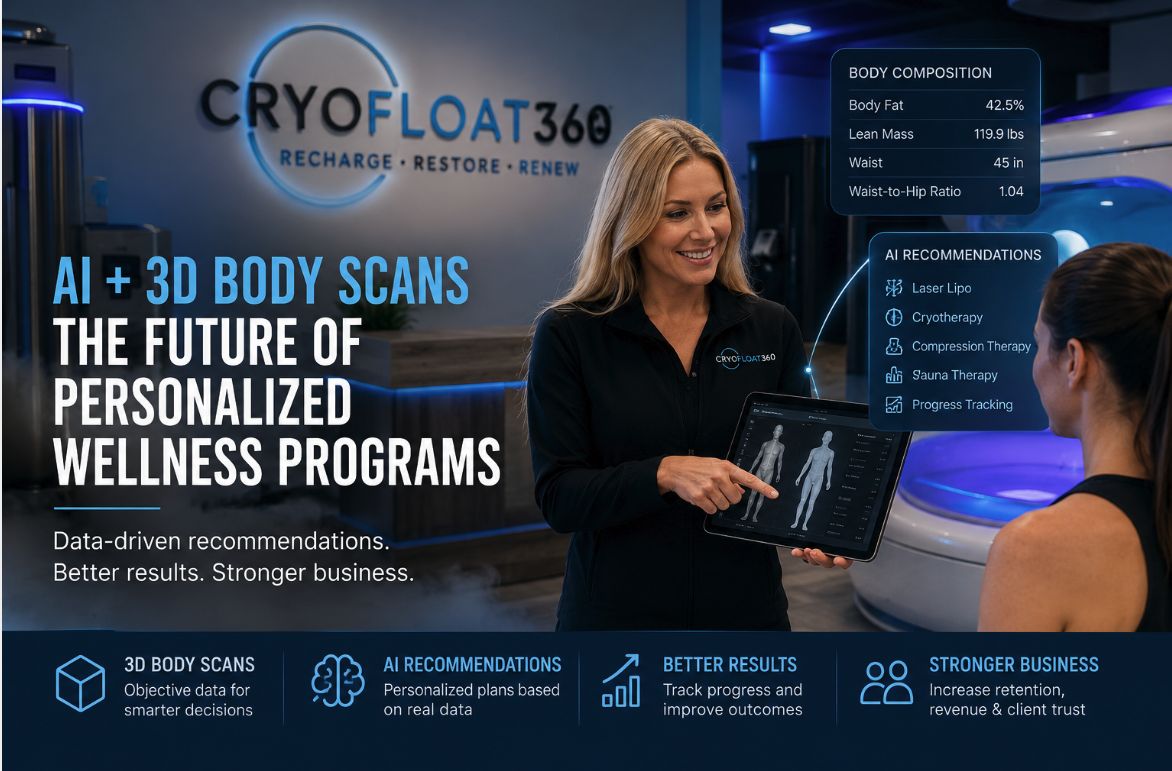
Wellness Centers Use AI and 3D Body Scans for Personalized Treatment Plans
How can I use 3D Body Scans with AI Tools for Smart Recommendations?
Artificial intelligence is quickly becoming one of the most powerful tools in the wellness, recovery, fitness, and med spa industries. One client shared with us how are they using Fit3D scans with these tools to provide an optimal mix of their services to improve their programming per client.
This is a great illustration of using AI to add to your services without taking anything away.
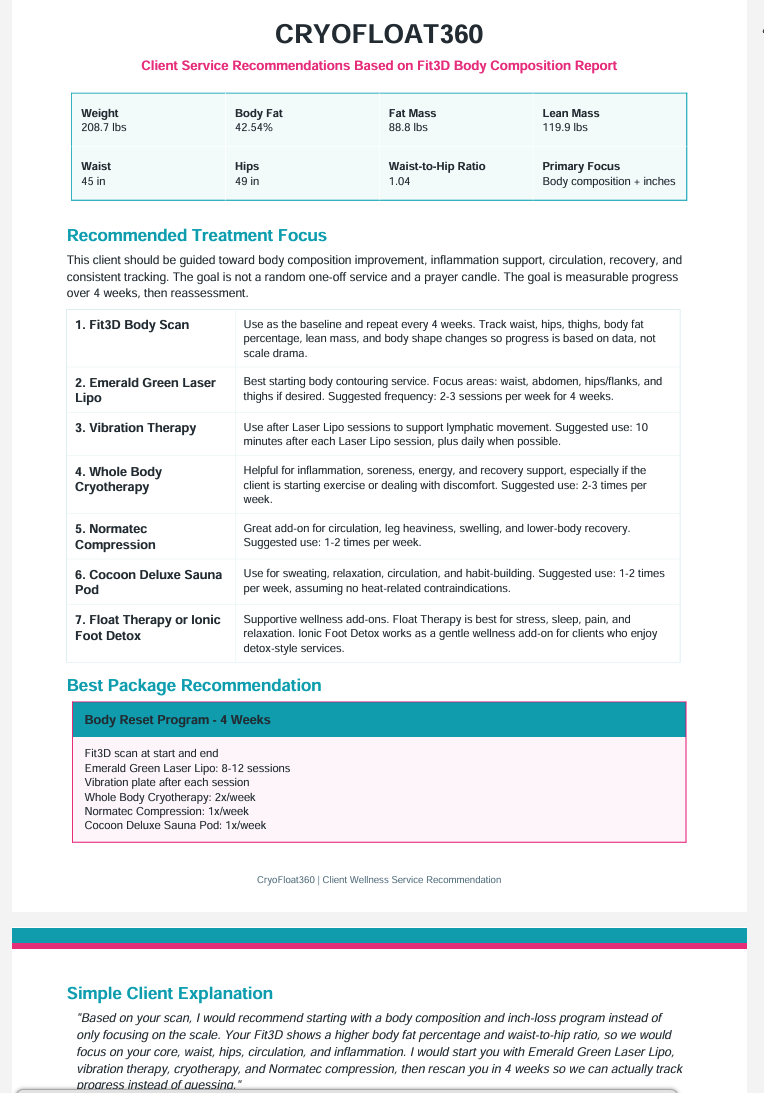
At Fit3D, we're seeing a growing number of operators use body composition assessments as the starting point for AI-powered wellness recommendations. We've attached an example at the end of this post.
What Is an AI-Powered Wellness Recommendation?
An AI-powered wellness recommendation combines body scan data, client goals, and available services to suggest a personalized treatment plan.
Instead of asking a client which service they want to purchase, the operator starts with objective measurements and uses that information to determine which services may deliver the best outcome.
This shifts the conversation from selling individual services to building customized wellness programs.
What do Body Scans Provide?
The challenge with many wellness consultations is that recommendations are often based on opinions rather than measurements.
A 3D body scan provides objective data including:
- Body fat percentage
- Lean mass
- Circumference measurements
- Waist-to-hip ratio
- Body shape changes over time
- Progress tracking across multiple visits
This data creates a baseline that can be used by both staff and AI systems to recommend services more accurately and track results over time.
Compared to legacy BIA machines that are influenced by water intake, 3d scans are very consistent. Plus, they give amazing visuals that people can see changes over time versus just looking at chart.
Real-World Example: CryoFloat360
One operator embracing this approach is CryoFloat360.
According to Mandy, a leader at CryoFloat360:
"Absolutely. We are actually putting together a coaching program and incorporating this into our business with AI to help clients see what services that we offer will fit them best. I did it for myself and the results were great."
Rather than treating every client the same, CryoFloat360 is building a coaching framework that combines 3D body scan results with AI-generated recommendations to create personalized wellness programs.
How AI Can Tailor Wellness Packages for Clients?
When paired with body composition data, AI can help identify which services may be most relevant for a client's goals.
For example, a client focused on body composition improvement may receive recommendations centered around:
- Body contouring
- Recovery services
- Circulation support
- Inflammation reduction
- Progress tracking and accountability
In one example generated from a Fit3D assessment, the recommended program combined body composition tracking, laser lipo, cryotherapy, compression therapy, sauna treatments, and periodic reassessments to measure progress.
The goal is to create a structured paths that helps clients achieve measurable results - which directly impacts retention & satisfaction. Revenue is a secondary passive result.
Benefits for Wellness Centers and Med Spas
AI-powered treatment recommendations offer several business advantages:
- Higher Package Sales
- Improved Client Retention
- More Consistent Staff Recommendations
- Better Client Outcomes
The Future of AI in Wellness
The future of wellness centers, med spas, recovery studios, and body contouring clinics will not be built on one-size-fits-all packages.
The most successful operators will combine three key elements:
- Objective body composition data
- Artificial intelligence
- Personalized coaching & communication
Businesses that use AI and 3D body scans together can create more personalized treatment plans, improve client retention, increase package sales, and deliver a better overall customer experience.
As operators like CryoFloat360 demonstrate, AI is becoming more than a technology trend. It is becoming a practical tool for helping clients understand where they are today, where they want to go, and which services can help them get there.

Subscribe to
our Newsletter!
